
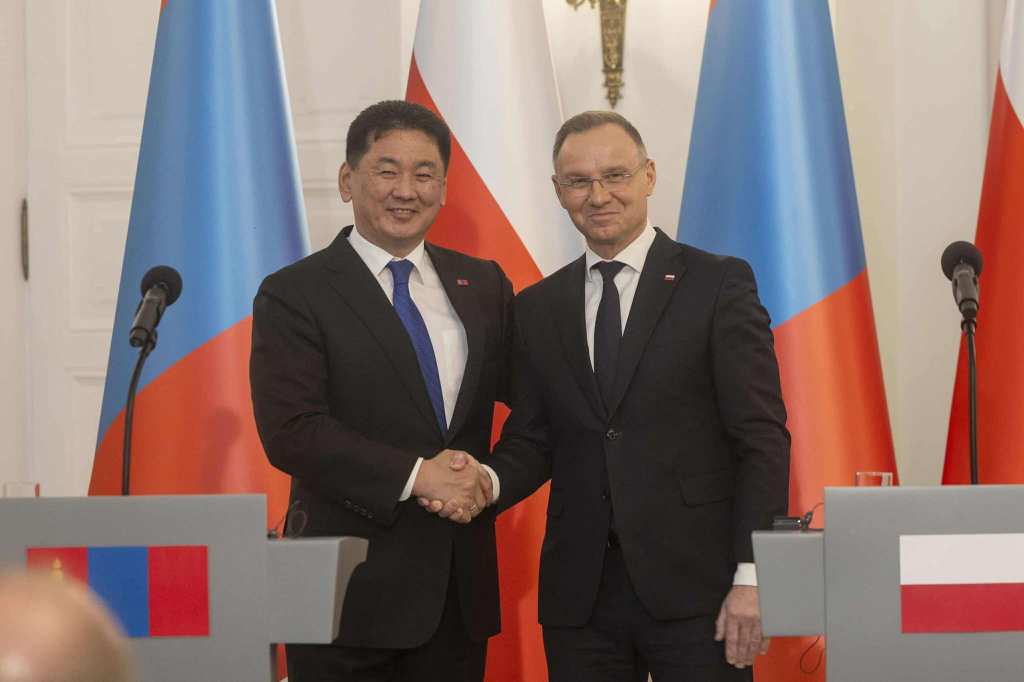
A historic state visit marked a new chapter in Mongolia–Poland relations, rooted in shared democratic values and expanding strategic cooperation.
Mongolia’s President Khurelsukh Ukhnaa paid a state visit to Poland from March 13-14, 2025, during which Mongolia and Poland elevated their relations to a “Comprehensive Partnership”. The state visit took place within the framework of the 75th anniversary of diplomatic relations between the two countries and marked the first state visit to Poland by a Mongolian head of state in 12 years.
Mongolia and Poland share a rich history, dating back to the 13th century when the Mongol Empire invaded the Polish Kingdom during its westward expansion. While initially marked by conflict, this early contact was the beginning of a long-standing relationship that would evolve over the centuries.
Formal diplomatic ties between the two nations were established on April 14, 1950, when Poland became one of the first European countries to recognize Mongolia. The bilateral relations are marked by a rich legacy of academic, scientific, and cultural exchange that dates back decades. Since the mid-1960s, the two nations have collaborated actively in fields such as history, ethnology, paleontology, and biology. For example, from 1963 to 1971, joint paleontological field surveys in the Gobi, led by their respective scientific academies, yielded significant fossil discoveries along with numerous other findings.
These scientific ties were complemented by educational exchange as Polish universities became a popular destination for Mongolian students, a tradition that continues today with 25 students enrolling in Poland annually, and many more pursuing postgraduate studies. This long-standing academic cooperation has not only supported the development of individual careers but has also contributed to broader institutional relationships between universities and research centers in both countries.
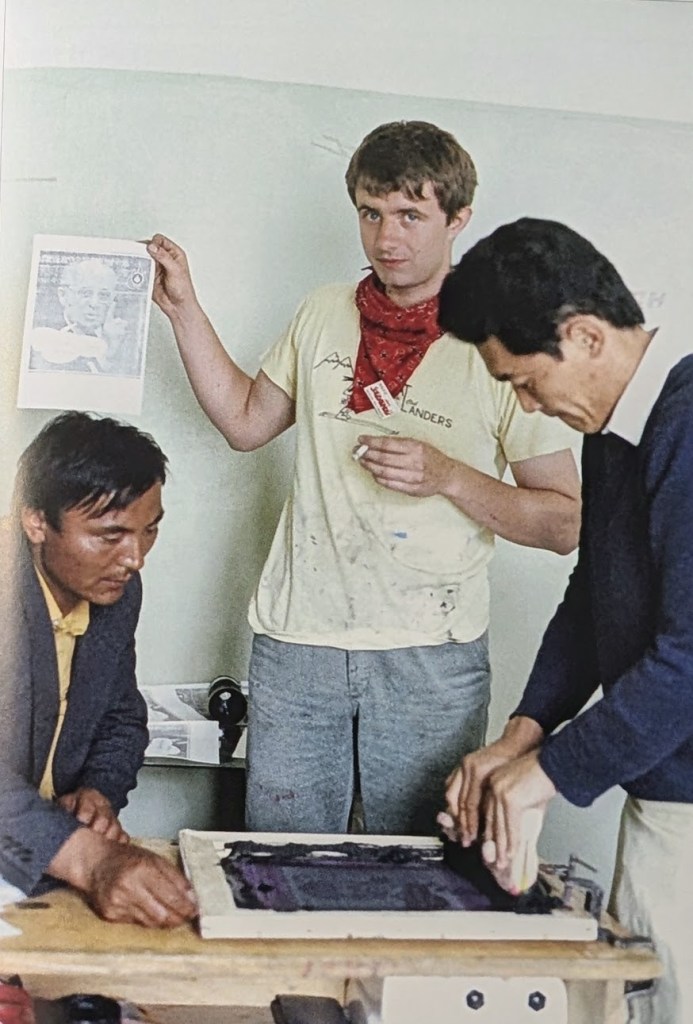
In the early 1990s, as both countries transitioned away from communism, Mongolia-Poland ties took on new democratic dimensions. During Mongolia’s 1990 Democratic revolution, Polish Solidarity activists extended direct support to Mongolian pro-democracy activists. A group of Poles even traveled to Mongolia to assist with the production of leaflets and posters. Following the revolution, Polish experts played a role in drafting Mongolia’s 1992 Constitution, drawing upon shared values of democracy, human rights, and freedom, values which continue to anchor the bilateral relationship today.
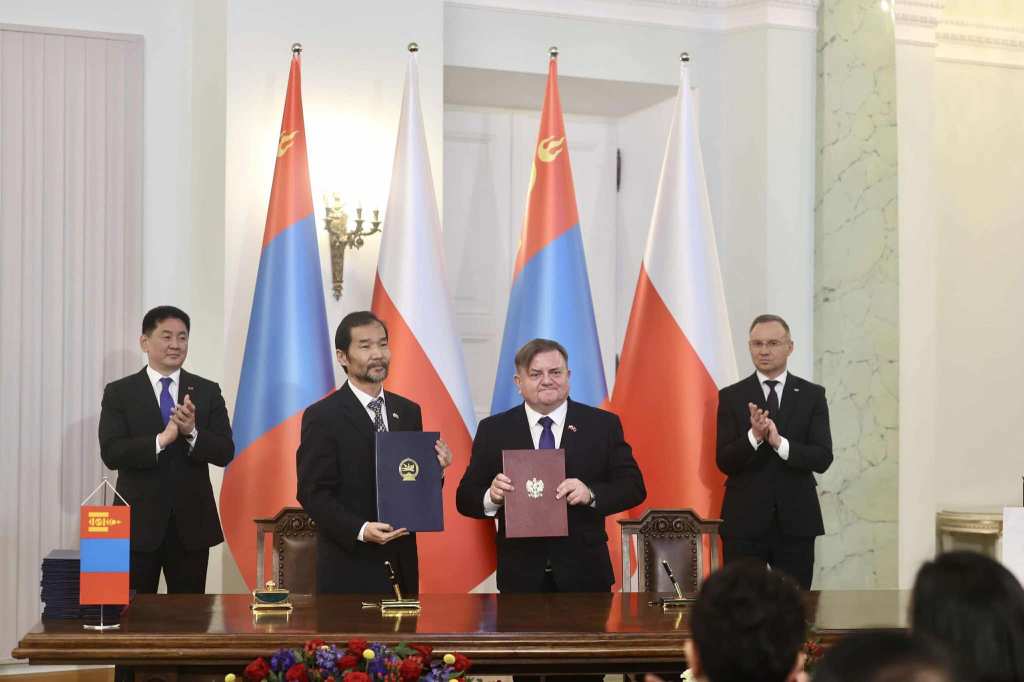
During Mongolian President U.Khurelsukh’s state visit, Mongolia and Poland signed the 2025–2030 Action Plan for their Comprehensive Partnership, outlining a roadmap for deeper cooperation. The two sides signed 13 cooperation agreements spanning healthcare, defense, education, science, media, and cultural exchange, as well as agreements between universities and local governments.
Mongolian Ambassador to Poland Oyundari Navaan-Yunden noted that the Action Plan for the partnership and the accompanying cooperation agreements allowed “both sides to assess the current state of Mongolia-Poland relations, elevate them to a new level, and define future prospects, which proved mutually beneficial.”
The two countries also committed to doubling bilateral trade to 200 million USD and enhancing investment in food processing, livestock product exports, infrastructure, and logistics. Poland also expressed interest in investing in Mongolia’s “New Kharkhorum” city project, heavy industry, public transportation, and wastewater treatment plants. In addition, under Mongolia’s “Food Supply and Security” and “White Gold” programs, the parties discussed expanding cooperation in the agriculture and light industry sectors to enhance domestic production, introduce advanced technology, and increase exports.
Marking the historical visit, the Polish Ambassador to Mongolia, Krzysztof Bojko told Arctus Analytics,
“President U.Khurelsukh’s visit was a confirmation of growing bilateral relations, with the most significant outcome being the elevation of relations to a new level of Comprehensive Partnership.”
The Ambassador stated that the President’s state visit achieved tangible results and it was rich in both political and economic substance.
As part of the state visit, the Mongolia-Poland business forum was held in Warsaw with representatives from over 200 companies and government institutions from both countries in attendance. During the event, Mongolian President U.Khurelsukh reaffirmed Mongolia’s commitment to being a “reliable, trustworthy, and long-term partner” and emphasized what an important trading partner Poland is for Mongolia. Polish President Andrzej Duda spoke about the growing interest of Polish business in the Mongolian market and noted that the two countries have tremendous potential to increase economic cooperation, adding that over the past five years, their trade turnover had almost doubled.
As of 2024, trade between Mongolia and Poland amounts to 105 million USD, with Mongolia exporting over 1 million USD in goods and importing approximately 104 million USD worth of products from Poland, with Poland being Mongolia’s third largest EU trade partner.
Ambassador Krzysztof Bojko emphasized that the goal of increasing bilateral trade from the current 100 million to 200 million USD is an achievable goal, especially given the potential for Mongolia to export agricultural products such as wool, cashmere, leather, pharmaceuticals, and meat to Poland. However, he noted that for unprocessed agricultural goods, particularly meat, there remains the issue of meeting the European Union’s standards and requirements. He also acknowledged the challenges posed by geographic distance and transportation logistics in trade, as well as obstacles resulting from the ongoing Russia-Ukraine war. Nevertheless, Ambassador Bojko expressed optimism that the war will eventually come to an end and that Mongolia-Poland trade will expand in the future.
In addition, people-to-people ties between the two countries continue to expand. Approximately 1,000 Mongolian citizens currently reside in Poland, including around 170 students studying under the framework of the “Ilgeelt-2100” initiative, launched by the President of Mongolia. There is also broad potential for cooperation in the fields of culture, education, and tourism. The number of Polish tourists visiting Mongolia has been increasing annually, and both sides view tourism as a priority sector for future bilateral cooperation.
When asked about possible ways of expanding Mongolia – Poland economic cooperation, Mongolian Ambassador N.Oyundari said:
“Beyond merely increasing trade volume, Poland expressed strong interest in enhancing mutual investment and deepening economic ties by jointly working on processing and producing dairy, meat, and meat products, as well as collaborating on infrastructure, air and rail transport, and logistics, areas which are seen as essential for elevating the quality of the economic partnership.”
Mongolia’s deepening partnership with Poland is a clear reflection of its broader “Third neighbor” policy, which seeks to build strong, diversified ties with countries beyond its two immediate neighbors, China and Russia. As a member of both NATO and the European Union, Poland has become an increasingly important European partner for Mongolia, grounded in historical solidarity and a shared commitment to democracy.
At the same time, Mongolia’s unique geographic location offers opportunities for Poland. The country could serve as a strategic gateway to China and further into Northeast Asia. Engaging with Mongolia, an open, democratic country, allows Poland to diversify its engagement in Asia, participate in Eurasian political dynamics without high-risk entanglements and extend its influence in a geostrategically sensitive corridor between Russia and China.
As both sides look toward implementing joint projects in agriculture, infrastructure and industrial processing, the foundation is now set for Mongolia and Poland to move beyond their historical friendship and toward a more dynamic and mutually beneficial economic partnership.
 Арктус Аналитикс ХХК
Leave a comment