
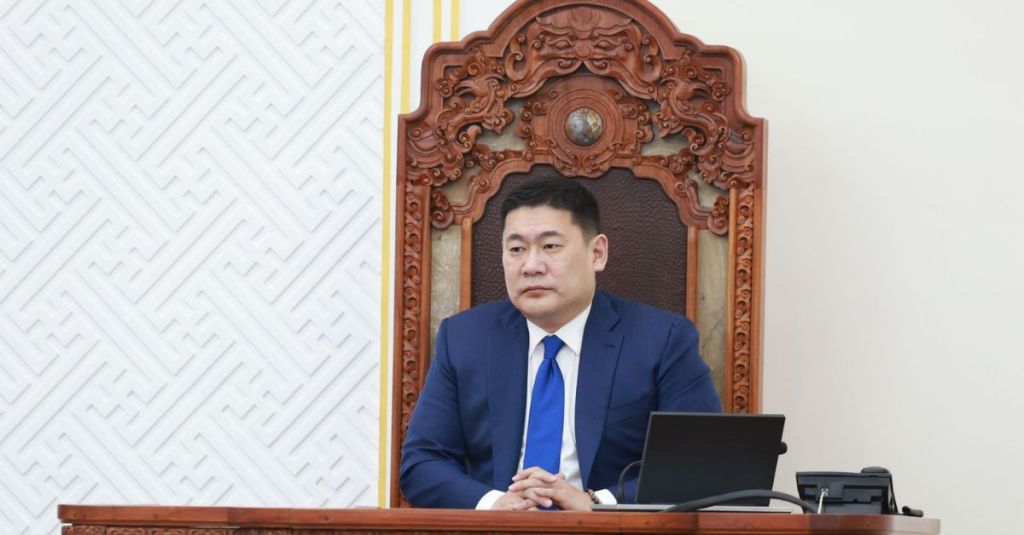
Mongolia’s political landscape has been thrown into turmoil following revelations about Prime Minister L.Oyun-Erdene’s son’s lavish lifestyle, which have sparked youth-led protests now entering their third week. As pressure mounts, the fate of the ruling “Courage for Accelerated Development” coalition — an alliance of the Mongolian People’s Party (MPP), the Democratic Party (DP), and the HUN Party — now hangs in the balance. With a critical confidence vote looming in Parliament, Mongolia faces several possible political scenarios that could reshape the country’s governance and policy direction in the months ahead.
1. Brief Summary of the Current Political Situation
Public outrage has surged following revelations about Prime Minister L.Oyun-Erdene’s son’s lavish lifestyle, igniting widespread protests under the slogan “Resignation Is Easy,” which have now entered their 17th day. The demonstrations, driven largely by younger citizens, reflect broader demands for justice, political accountability, and ethical governance. In response to mounting pressure, Prime Minister L.Oyun-Erdene has refused to voluntarily resign and instead referred the matter to Parliament, requesting a formal vote of confidence to resolve the political impasse. Meanwhile, the governing coalition has begun to unravel, with the DP formally announcing its withdrawal from the alliance. This has further destabilized the government’s standing and set the stage for a critical showdown in Parliament.
2. Parliamentary Voting Conditions and Possible Phrasing of the Motion
The Parliament will soon convene to deliberate a vote of confidence in Prime Minister L.Oyun-Erdene, a process whose outcome depends heavily on both the wording of the motion and the voting behavior of MPs. In Mongolia’s parliamentary rules, the specific phrasing of the motion influences how abstentions and absences are counted, giving political parties room for tactical maneuvering. The Parliament is expected to discuss the confidence motion under one of the following formulations:
A. “Parliament expresses confidence in the Prime Minister”
- In this case, MPs who do not support the confidence motion, or who registered their attendance but left without participating in the vote, will automatically be considered as having voted to dismiss the government.
- If DP members register attendance but abstain or leave during the vote, the motion may fail, increasing the likelihood of the government falling.
B. “Parliament do not express confidence in the Prime Minister”
- Only MPs who actively vote against the motion are counted as seeking the government’s resignation, while abstentions or absences do not directly contribute to ousting the Prime Minister.
In either case, the MPP will need to maintain a unified internal vote, while opposition parties, particularly DP, HUN, National Coalition (NC), and Civil Will-Green Party (CWGP), will weigh their attendance and voting tactics carefully to influence the outcome.
3. Where the Parties Stand
| Caususes, Number of Seats | Positions, Scenarios |
| MPP (68) | MPP’s support is crucial. Internally split, with some MPs undecided. |
| DP (42) | Officially left the government and plans to vote against confidence. |
| HUN Party (8) | Soft opposition to the PM, though some members may lean toward support. |
| NC + CWGP (4+4) | Likely to oppose, but positions may vary by individual. |
4. Possible Scenarios and Their Political Consequences
Scenario 1: The Government Survives the Confidence Vote
Likelihood: Moderate (50–60%) — Depends on MPP internal divisions and DP’s voting tactics (e.g., attending but abstaining).
Political Implications: If Prime Minister L.Oyun-Erdene retains Parliament’s confidence, his government will continue — though with diminished legitimacy. Public trust in both the administration and Parliament is likely to erode further, especially among younger voters. While this outcome would allow ongoing initiatives like the “14 Mega Projects” and the establishment of a Sovereign Wealth Fund to proceed, the government would face escalating political pressure. Opposition forces are expected to intensify narratives of “elite collusion” and unaccountable governance, while street protests would likely persist or even escalate.
Scenario 2: Confidence is denied, and the Government falls
Likelihood: Moderate (40–50%) — Depends on strong opposition by DP and smaller parties.
Political Implications: If the confidence motion fails, Mongolia would enter a period of political uncertainty. Under constitutional rules, a new Prime Minister must be nominated within 30 days, with potential candidates including MPP figures such as S.Amarsaikhan, G.Zandanshatar, or N.Uchral. In the interim, progress on mega projects and the Sovereign Wealth Fund would likely stall, and internal divisions within the MPP could deepen, potentially triggering new factional alignments. This scenario would also expand President U.Khurelsukh’s influence, as the constitution grants him a key role in shaping the next government.
Scenario 3: Prime Minister voluntarily resigns
Likelihood: Low (under 10%) — Though it could offer a political off-ramp, L.Oyun-Erdene’s rhetoric suggests resistance.
Political Implications: Although unlikely, a voluntary resignation could provide a political off-ramp and help de-escalate public unrest. Such a move would be perceived by some as a responsible gesture, but would also open intense internal competition within the MPP for the nomination of a successor. The fate of current flagship projects would depend largely on the orientation of the incoming Prime Minister and their ability to stabilize the political landscape.
5. Conclusion: A Pivotal Moment for Mongolia’s Political Future
Parliament’s upcoming decision will shape far more than the political fate of Prime Minister L.Oyun-Erdene, it will determine the stability of Mongolia’s governance, the credibility of its institutions, and the trajectory of key national projects. At a time when public trust in politics is already fragile, the handling of this crisis will send lasting signals to both domestic and international audiences.
The most volatile factor remains parliamentary attendance and voting behavior, as parties and factions weigh not only their formal positions but also their tactical moves on the floor. Behind the scenes, both government and opposition forces are likely to leverage procedural nuances to sway the outcome. Whatever the result, the current wave of youth-driven protests and the impending parliamentary session on June 2 represent a defining juncture for Mongolia’s political landscape. The outcome will reshape the trends and alignments that have shaped national politics over the past six to seven years.

 Арктус Аналитикс ХХК
Leave a comment