
Key takeaway: A 61% ministerial shake-up gives PM G.Zandanshatar fresh technocratic talent, but internal MPP factions and a newly emboldened opposition could still threaten Cabinet longevity.
The new Cabinet’s survival will hinge on how swiftly it delivers policy wins while placating rival MPP factions and a sharpened opposition.
The Next Coalition and The Current Government
On 17 June 2025, Mongolia’s Parliament confirmed Prime Minister Zandanshatar Gombojav’s coalition Cabinet, replacing 11 of 18 ministers – a 61 percent turnover – without touching the government’s basic architecture. The line-up keeps the familiar 16-ministry, three–Deputy-Prime-Minister format of the Oyun-Erdene Cabinet; it simply scraps the ministers-without-portfolio post and reallocates their oversight duties, signalling a drive to streamline while preserving technocratic continuity.
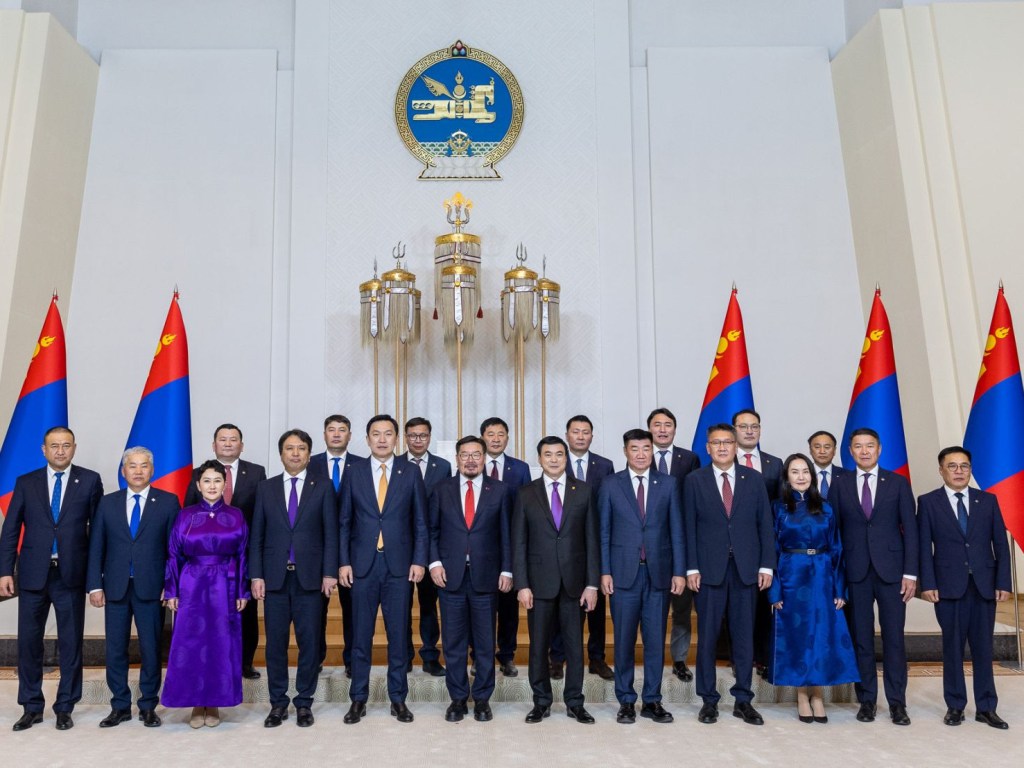
Among the most notable appointments is N.Uchral, now serving as both Deputy Prime Minister and Minister of Economy and Development, underscoring the priority placed on economic governance. He is joined by S.Amarsaikhan from MPP and T.Dorjkhand from HUN Party as fellow Deputy Prime Ministers. Other so-called technocratic appointments include B.Batsetseg continuing as Foreign Minister, B.Javkhlan remaining at Finance, and J.Chinburen at Health – ministers with proven track records and sectoral credibility.
At first glance, G.Zandanshatar’s administration reflects a careful balance between political necessity and technocratic continuity. Beneath this reshuffle, however, sits a broader political recalibration that will determine whether G.Zandanshatar’s government stabilizes Mongolia’s governance or becomes the next casualty of the country’s intensifying political turbulence.
Democratic Party’s Exit and Realignment of Coalition Politics
A key shift in this new political configuration is the exit of the Democratic Party (DP) from the MPP-led coalition government. Their exit is both ideological and strategic: by going into opposition, the DP hopes to capitalize on public discontent and differentiate itself ahead of the 2027 presidential election.
The Democratic Party’s departure allowed the MPP to consolidate power, securing 16 of the 19 cabinet posts – about 84 percent – while still allocating a limited share to smaller partners to preserve coalition legitimacy. The HUN Party retains two portfolios (Deputy Prime Minister T.Dorjkhand and Education Minister P.Naranbayar), and the Civil Will – Green Party enters the Cabinet through Environment and Climate Change Minister B.Batbaatar. Although numerically modest, these allies give the administration a recognisably multi-party profile even as real decision-making authority rests firmly with the MPP.
While the MPP remains the dominant force in the cabinet, this reshuffle exposed growing internal divisions. The party is increasingly fractured between the ‘Veterans’ (multiple-term, senior pro-Cabinet MPs) who have secured key posts in the current government and the younger, reformist ‘Chicks’ (first-term, junior anti-Cabinet MPs), which now commands around 30 seats in Parliament. This 30-seat ‘Chicks’ bloc has become a formidable parliamentary check when added to the 42-seat DP opposition.
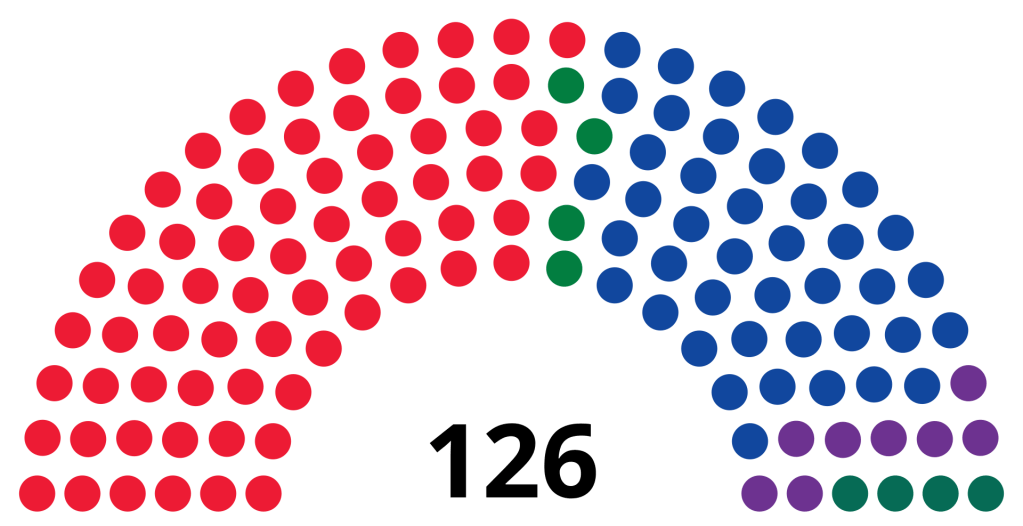
Mongolia is, by law and practice, a parliamentary democracy. The current 126-seat parliament, the State Great Khural, comprises the MPP (68 seats), the DP (42), the HUN Party (8), the Civil Will – Green Party (4), and the National Coalition (4). Despite MPP’s parliamentary majority, its internal cohesion is being tested.
The combined strength of the opposition and dissident MPP faction can now form a strong opposition with the power to bring down the new Cabinet amid rising political instability. This creates a precarious environment for PM G.Zandanshatar, whose leadership style is seen as more conciliatory and discreet compared to his predecessor.
A Delicate Balancing Act: Strong Opposition VS Quiet Strength in Noisy Times
The reshuffled Cabinet is framed as a technocratic answer to Mongolia’s increasingly complex political landscape, yet its longevity will rest on Prime Minister G.Zandanshatar’s ability to navigate diverse parliamentary interests. By assigning key portfolios across rival factions, he is signalling a preference for steady policy execution and measurable results over headline-grabbing confrontation.
Yet, with internal opposition poised and external pressure mounting, this coalition Cabinet could prove either a stabilizing force or the focal point of renewed turbulence as Mongolia approaches its next political crossroads.
The MPP’s internal factions may soon shift from quiet dissent to open rebellion. The DP is already sharpening its knives. Thus G.Zandanshatar, despite his new constitutional powers, will need more than procedural control, he will need political finesse.
In his first address as head of government, Prime Minister G.Zandanshatar emphasized the need for ministers to rise above party allegiances and focus on national unity, ethical governance, and public service. He highlighted that appointments were based on professional experience, administrative capacity, and personal integrity, aligning with the government’s long-term development strategies.

Known more for institutional reform and his low-key style as former Speaker of Parliament, he entered the premiership as a consensus figure – respected across camps. Yet ironically, G.Zandanshatar may now be the most powerful Mongolian Prime Minister after L.Oyun-erdene since the 2019 constitutional amendments. These revisions grant the Prime Minister full authority to appoint and dismiss cabinet ministers without parliamentary approval. In political terms, G.Zandanshatar inherited tools that neither his predecessor L.Oyun-Erdene nor any leader since the socialist-era strongman Yumjaagiin Tsedenbal could wield as decisively. But power alone is not protection.
Post-Coalition Outlook: Stability or Storm?
The new coalition Cabinet is a wager that solid governance can outshine tactical manoeuvering. Yet it enters a Parliament more fragmented than ever, in a political environment where loyalties shift quickly and factional rivalries are on the rise. Whether this government becomes a platform for policy continuity or a trigger for renewed turmoil may depend less on its competence, and more on its capacity to navigate the shifting sands of Mongolian politics.
In the months ahead, Mongolia will test not just a new government, but the very resilience of its parliamentary system. Will pragmatic management prevail, or will mounting opposition, inside and outside the ruling party, turn today’s quiet administration into a high-profile casualty?
 Арктус Аналитикс ХХК
Leave a comment