
By B.Gunbileg, Guest Contributor
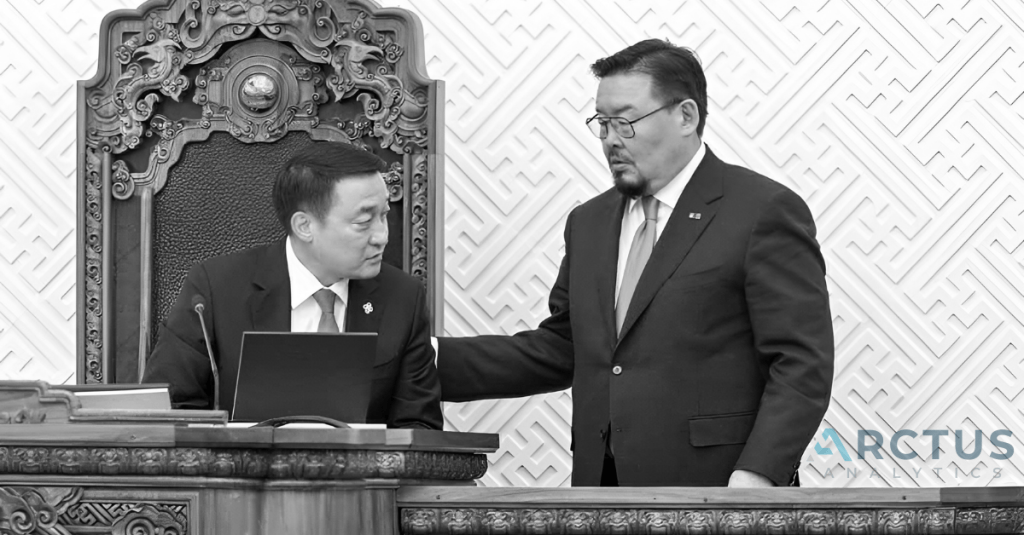
At the center of Mongolia’s political stage, Prime Minister Gombojav Zandanshatar and Parliament Speaker Dashzegve Amarbayasgalan are vying for control of the ruling party. On the 27th of this month, the Mongolian People’s Party (MPP) will convene its Party Conference, and according to the party charter, the party chairman must be elected by two-thirds of the conference members. If neither candidate secures two-thirds, the matter will be decided at the Party Congress.
At present, MPP Secretary General D. Amarbayasgalan is likely to gain majority support among the Party Conference members, though it remains doubtful whether he can get two-thirds of the vote. This is because President U. Khurelsukh is backing Prime Minister G. Zandanshatar.
Currently, in the media and on social media, both candidates are actively spreading negative information about each other, which is evident to the public. This works to the advantage of the Democratic Party (DP), now in opposition, as its members actively amplify such negative information and add their own commentary. Stories portraying both candidates as common thieves and criminals have circulated, though none have been formally established by law enforcement agencies.
The Mongolian People’s Party, rooted in its history as a former communist party, has traditionally operated in a non-democratic, top-down manner, where orders from above are carried out without question. This time, however, a slightly different trend seems to be emerging. For instance, Prime Minister Zandanshatar’s side nominated L. Enkh-Amgalan for the position of parliamentary caucus leader, but MP J. Bat-Erdene put himself forward and ultimately became the MPP group leader. This challenged the notion that party members simply follow instructions from above without resistance.
In Mongolia, whoever controls the law enforcement system – especially the Prosecutor’s Office – has long been seen as the country’s “khan.” This is because the Law on the Prosecutor’s Office enshrines a top-down command structure. Local prosecutors are legally required to obey the instructions of higher-level prosecutors. Thus, if a superior prosecutor orders a lower-level prosecutor to open, close, or suspend a case, it must be followed. Under the Constitution, the President appoints the Prosecutor General, who in turn carries out the President’s instructions, often initiating criminal cases against political rivals. This practice has become a frequent target of public criticism.
Criminal proceedings have been launched recently against a number of political actors, a development that underscores how prosecutions continue to shape Mongolia’s political landscape. In this sense, Prime Minister G. Zandanshatar, backed by the President, appears to have strong protection and support. Yet as an individual politician, Zandanshatar’s position is less firm. In the 2024 elections, while serving as Speaker, he ran in an electoral constituency consisting of Arkhangai, Bayankhongor, and Uvurkhangai provinces with a total of 10 mandates and failed to crack the top ten candidates. His ambition is to run in the 2027 presidential election and succeed the current president. Among MPP members, he has been criticized as someone who “rode the elevator straight up to the Prime Minister’s office.” Meanwhile, since the Constitution allows the President to serve only once for a six-year term, the current President has a clear interest in maintaining influence by ensuring a close ally becomes the next head of state.
So far, no other politician besides these two has announced candidacy for the MPP chairmanship. Although party members have looked for a third option, no such figure has emerged. No one has dared to challenge for the leadership of Mongolia’s largest and longest-ruling party, still rooted in its communist legacy.
Last week saw a flurry of posts, articles, and interviews from supporters of both sides, marked by mutual denial and confrontation, though this week the intensity seems to be subsiding. While the two appear to be strong rivals, in the end they may reach a compromise: Speaker D. Amarbayasgalan becoming MPP Chairman, while G. Zandanshatar continues as Prime Minister until next spring.
But the bigger question remains before us: Who will be the new Prime Minister in the spring of 2026?
 Арктус Аналитикс ХХК
Leave a comment