
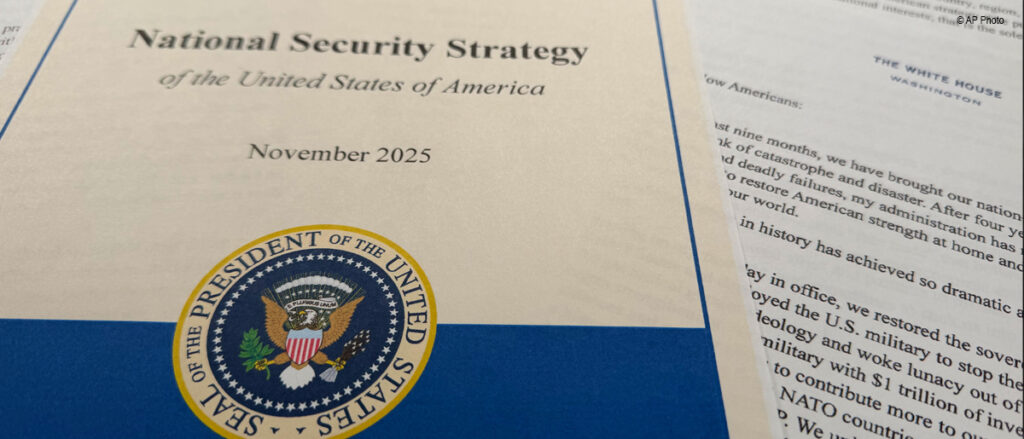
The administration of U.S. President Donald Trump publicly unveiled its updated National Security Strategy in December 2025. Prior to this, the previous strategy had been updated in 2022 under President Joe Biden. The National Security Strategy is a foundational document that defines how the United States understands its role in the world, which regions and issues it prioritizes, and how it intends to engage with its partners. The newly adopted strategy makes clear that U.S. foreign policy is shifting toward a more pragmatic, selective, and interest driven approach.
Mongolia – U.S. relations have developed steadily within the framework of Mongolia’s “Third Neighbor” policy, grounded in shared values such as democracy, human rights, and the rule of law. However, as U.S. foreign policy priorities and evaluation criteria evolve, placing greater emphasis on strategic relevance and tangible returns, the question inevitably arises as to how Mongolia should further develop its relationship with Washington, and how it can ensure that bilateral ties remain meaningful, resilient, and strategically relevant going forward.
Against this backdrop, this article examines the core concepts and key trends outlined in the United States’ 2025 National Security Strategy and assesses the implications, constraints, and limited opportunities they present for Mongolia’s foreign policy, particularly in the context of Mongolia – U.S. relations.
Core Directions of the New Strategy
In the newly adopted National Security Strategy, the Trump administration clearly reiterates its “America First” approach, placing U.S. national interests at the center of foreign policy decision making. The strategy identifies strengthening U.S. influence in the Western Hemisphere and ensuring stability in that region as a primary foreign policy priority.
Whereas the United States previously viewed itself as a global guarantor of international order and sought to distribute its attention broadly across global challenges, the new strategy explicitly abandons this assumption. It acknowledges that not all regions and issues can occupy the center of U.S. foreign policy simultaneously and emphasizes the need to evaluate, sort, and prioritize based on strategic importance, focusing attention primarily on regions and issues where core U.S. national interests are directly implicated.
The strategy further defines economic security as the foundation of national security. Strengthening the U.S. economy and preserving technological advantages are elevated as top strategic objectives. Trade policy, domestic manufacturing, energy security, and access to critical minerals are identified as areas of strategic importance. In addition, responsibility for monitoring supply chains and economic dependencies is assigned to intelligence and national security institutions, underscoring a broader shift toward treating economic policy as an integral component of national security.
The document also signals a more transactional approach toward allies and partners. It emphasizes reciprocity, mutual benefit, and burden sharing in both economic and security domains. Partnerships are no longer framed primarily in normative or value based terms, but increasingly assessed on the basis of concrete contributions, alignment with U.S. strategic priorities, and measurable outcomes.
The Current State of Mongolia – U.S. Relations: Stable, but Limited
Since establishing diplomatic relations in 1987, Mongolia has steadily developed its relationship with the United States under its Third Neighbor policy, elevating ties to the level of a Strategic Partnership in 2019. Bilateral relations have been anchored in shared democratic values, and Mongolia’s active participation in international peacekeeping operations has contributed to closer defense cooperation. In this sense, Ulaanbaatar maintains a politically stable, positive, and trust‑based relationship with Washington.
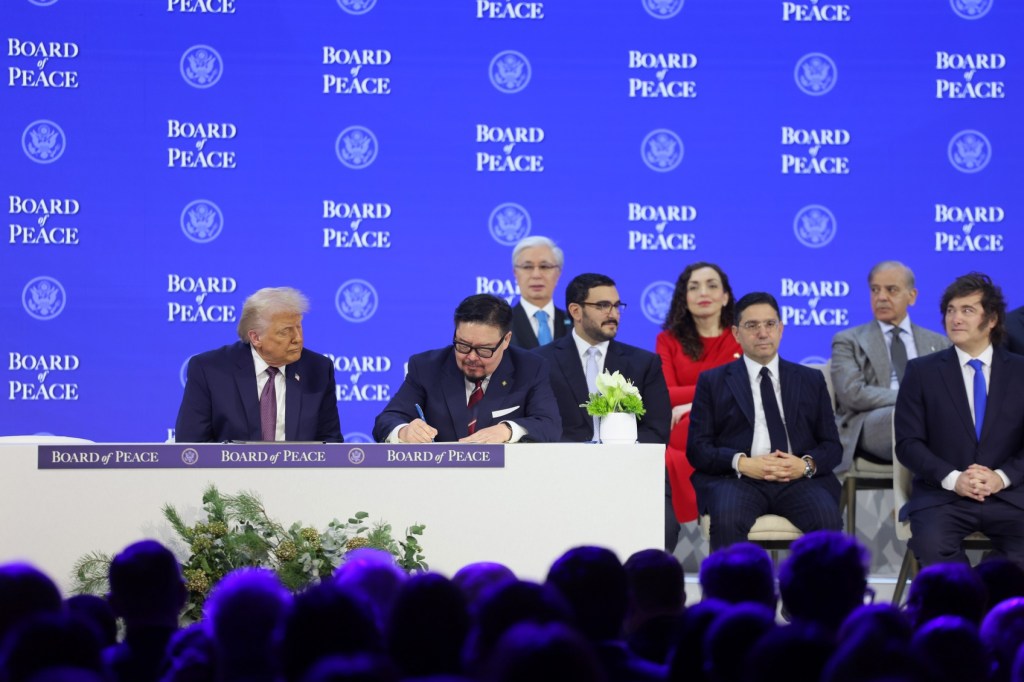
A recent example is Mongolia’s decision to join the U.S.-initiated Board of Peace as a founding member during the World Economic Forum in Davos. This move underscores the continued political and diplomatic trust between the two countries and reflects Mongolia’s willingness to engage with U.S.‑led multilateral initiatives.
Economically, however, Mongolia – U.S. relations remain relatively limited. Structural constraints such as Mongolia’s geographic location, small market size, and underdeveloped infrastructure continue to weigh on economic engagement. Bilateral trade has not exceeded 1 billion USD, U.S. foreign direct investment remains modest, and aside from the Millennium Challenge Corporation’s Water Supply Project, there are no major long term joint economic projects. As a result, while political relations are stable, the economic dimension of the relationship remains weak and narrow in scope, limiting its overall depth and resilience.
What Does Trump’s New Strategy Mean for Mongolia?
Based on the 2025 National Security Strategy, it would be inaccurate to conclude that Mongolia – U.S. relations are weakening or losing importance. Nevertheless, it is increasingly necessary to reassess the criteria by which the relationship will be evaluated in the coming years.
While shared democratic values have long defined Mongolia – U.S. relations, these alone are unlikely to be sufficient going forward. Under the logic of the new strategy, bilateral relations will be judged more heavily on tangible outcomes, strategic relevance, and economic returns. In this context, Mongolia must move beyond defining itself solely as a like‑minded democratic partner and instead develop concrete areas of cooperation that intersect with U.S. strategic priorities.
When the two sides announced the elevation of relations to a Strategic Partnership in 2019, they identified clean energy, critical minerals, food security, and the digital economy as priority areas for cooperation. Among these, the critical minerals sector stands out as a potential avenue for deepening economic engagement and creating sustained U.S. interest. As the United States seeks to reduce supply chain vulnerabilities and diversify sources of strategic raw materials, Mongolia has an opportunity to position itself as a reliable long term partner, provided it can offer a stable investment environment, regulatory predictability, and further political and macroeconomic stability.
At the same time, the impending completion of the Millennium Challenge Corporation’s Water Compact in March 2026 raises an important policy question: what form should bilateral cooperation take in the next phase? Under the Trump administration, the United States has significantly reduced foreign assistance and frozen or curtailed many international programs. In this environment, Mongolia will need to shift away from an aid‑based framework and toward cooperation grounded in joint investment, commercially viable projects, and shared economic interests.
Energy cooperation, particularly infrastructure development and the creation of new generation capacity, may offer one such pathway. Moving in this direction would not only align with U.S. strategic priorities but also contribute to Mongolia’s long term development objectives.
Conclusion
In conclusion, shifting global geopolitical dynamics and the influence of President Donald Trump have reshaped U.S. foreign policy toward a more pragmatic, interest‑based approach, a shift clearly articulated in the 2025 National Security Strategy. The strategy signals that relationships with other countries will increasingly be built not on shared values or goodwill alone, but on concrete substance, strategic alignment, and mutual benefit.
For Mongolia, this underscores the need to reassess how the significance of Mongolia – U.S. relations can be maintained and strengthened, and what concrete pillars should underpin the relationship going forward. Ultimately, the future depth and durability of bilateral ties will depend on how effectively Mongolia can align with U.S. strategic priorities and translate political goodwill into sustained, mutually beneficial cooperation.
Sources
- The White House. 2025 United States National Security Strategy.
https://www.whitehouse.gov/wp-content/uploads/2025/12/2025-National-Security-Strategy.pdf - Office of the United States Trade Representative. U.S.–Mongolia Trade Summary.
https://ustr.gov/countries-regions/china-mongolia-taiwan/mongolia - How the Curtailing of U.S. Aid Impacts Mongolia’s Development. The Diplomat, 2025.
https://thediplomat.com/2025/02/how-the-curtailing-of-us-aid-impacts-mongolias-development/
 Арктус Аналитикс ХХК
Leave a comment