
Bolor Lkhaajav | Policy Consultant, Op-Ed Contributor – Arctus Analytics
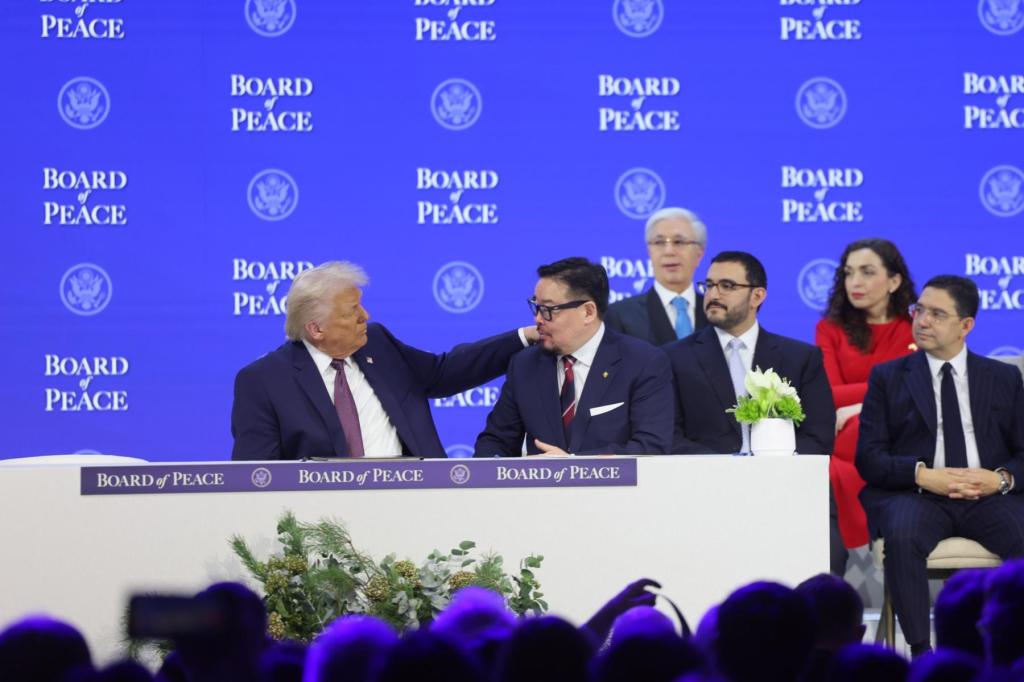
The 2026 World Economic Forum took place in a very different environment than previous years. This year’s Davos was not truly about global economics. It was about geopolitical shifts and how countries were about to respond to this rapid change. Leaders from France to Canada made sharp remarks, sparking a global debate on alliances and partnerships. Mongolia, too, did not miss the limelight. The country’s new Prime Minister Zandanshatar Gombojav, who was recently confirmed after a tumultuous political crisis, attended the Forum. During Davos, Mongolia officially joined the U.S. initiated Board of Peace as one of the founding members. Mongolian intellectuals and international observers are baffled about Ulaanbaatar’s decision to join the newly forming, Trump-led Board of Peace. There are legitimate reasons for these negative reactions.
On January 22, the U.S. President Donald J. Trump launched the Board of Peace, which was initially designed to oversee the 20-point Gaza Peace Plan and reconstruction of Gaza; it has now turned into an early stage of an international cooperative body that aims to resolve global conflicts. Trump’s son-in-law also introduced a power point presentation on how the Trump administration plans to reconstruct the Gaza Strip. As far as we know now, and according to Jared Kirshner himself, there is no Plan B, if the current plan doesn’t work. The reconstruction plan will require a sum of 25 billion USD. Davos was a platform for the Trump administration to pitch and invite investments.
Mongolia’s Membership to the Board of Peace
Mongolia’s swift move to join the newly forming international organization is drawing some criticism but the government pledges the membership aligns with Ulaanbaatar’s flexible, multi-pillared foreign policy, and protects its national interest. During the Charter Signing Ceremony, Mongolia became a Founding Member with 19 other countries. As of January 30, 2026, include the United States, Argentina, Armenia, Azerbaijan, Bahrain, Belarus, Bulgaria, El Salvador, Hungary, Indonesia, Israel, Jordan, Kazakhstan, Kosovo, Mongolia, Morocco, Pakistan, Paraguay, Qatar, Saudi Arabia, Turkey, the United Arab Emirates, Uzbekistan, and Vietnam are members to the Board of Peace.
Following the signature ceremony, Mongolia’s Prime Minister Zandanshatar administration announced that, “The Board of Peace is not a military alliance but a voluntary cooperation platform based on respect for national sovereignty, fully consistent with Mongolia’s independent, peace-centered and multi-pillared foreign policy.”
The Office of the Prime Minister told Bolor Lkhaajav that, “Mongolia’s joining to the Board of Peace also demonstrates its independent foreign policy mechanism.” Zandanshatar government’s official press release highlighted 3 key points for Mongolia’s decision to join the Board of Peace:
- As a responsible and peace-promoting country on the international stage, Mongolia’s support for a new, flexible, and result-oriented peace mechanism will strengthen Mongolia’s international position and provide an opportunity to make its voice heard more clearly, while also strengthening Mongolia’s security and independence through political and diplomatic means within the framework of international law.
- Mongolia has experience in actively participating in international peacekeeping and peace-support operations. The Board of Peace Charter is not a militarized alliance, but rather a voluntary cooperation of states, and respect for the sovereignty of states, which is fully consistent with Mongolia’s peace-promoting, independent, and multi-pillared foreign policy.
- The threshold of 1 billion USD specified in the Charter is a special provision related to the 3-year extension of membership for a member state, and it is not a mandatory condition for Mongolia or a condition that imposes real pressure. Mongolia does not have to make financial commitments to this extent and is fully able to participate as an ordinary member for a period of 3 years, on a voluntary basis, in a manner that suits its capabilities and interests.
In response to Mongolia’s membership to the Board of Peace, the U.S. Ambassador to Mongolia Richard Buangan said, “Congratulations to Prime Minister Zandanshatar, and we express our gratitude to Mongolia for becoming a founding member of the Peace Council. This historic initiative, being implemented under President Trump’s leadership, will finally bring peace to Gaza.”
From the U.S.–Mongolia bilateral relations standpoint, Mongolia’s acceptance of the membership is a continuation of U.S.–Mongolia strategic partnership, which was established during Trump’s first term in 2019. The Deputy Chief of Missions to the Mongolian Embassy in the United States Battushig Zanabazar told The Diplomat, “Joining this initiative at its initial stage as a founding member would provide Mongolia with a strategic advantage. Since the Board represents one of the key initiatives of the Trump administration to promote peace and stability, Mongolia’s early support and participation would send a tangible positive signal to the U.S. administration.” Battushig emphasized that “This would tangibly strengthen Mongolia’s Strategic Third Neighbor partnership with the United States and play a key role in deepening political trust.”
Mongolia’s International Obligations in Time of Transition
To keen Mongolia-observers, Ulaanbaatar might be jumping the guns to join various global initiations and organizations as it is aiming to maximize economic links. That being said, each organization and initiative require Mongolia to uphold certain values, principles, and actionable agreements and cooperation mechanisms. One of the examples is Mongolia’s membership to the International Criminal Court. In 2024, when Russian President Vladimir Putin paid a state visit to Mongolia in celebration of the 80th anniversary of the Battle of Khalkhiin Gol, Mongolia did not and could not arrest Putin. Geopolitically, this was an impossible move. Hence, what is the role for Mongolia’s membership to the ICC if there are no actionable mechanisms? The ICC, the European Union, and several other international organizations condemned Mongolia for failing the Rome Statute. It would also be prudent to highlight that the United States is not a member of the ICC either.
Compare that with Mongolia’s active contribution to the United Nations and its peacekeeping operations overseas. Mongolia has become one of the leading countries in peacekeeping mechanisms. Mongolia’s relations with the UN, too, have a history. Diplomats from the Tsedenbal Yumjaa era remember the struggle Mongolia had faced in order to gain a membership to the UN, only to get rejected several times. From a broader international historical standpoint, Mongolia’s presence and contributions has been globally accepted and continues to grow as different administrations and government agencies uphold certain values and principles that are accepted by the international community.
It also carries collective memory of what steps the country took during historical turning points at the end of the Second World War and the establishment of a new international order. Today, world politics is at the precipice stage of a turning point. In times of extreme uncertainties, small countries make decisions to protect its core national interest.
Shortcomings and Criticism
In the case with the Board of Peace, even U.S. allies in the Asia-Pacific are still reviewing the newly formed Board of Peace. Mongolia’s strategic partners such as Japan, South Korea, France, Poland, and many of its European partners – not only in spite of Trump’s international actions – but of genuine national interest are assessing the Charters, and the way which the international organization is planning to operate.
To the Zandanshatar administration, however, joining the Board of Peace may expand economic links with member states, which in this case, Mongolia had been strengthening bilateral relations with the Gulf States such as the United Arab Emirates, Bahrain, and Saudi Arabia. These economic endeavors will not or should not replace any other working mechanisms. Other than incorporating a bilateral mechanism, at this point, there is no clear benefit to Mongolia’s membership to the Board of Peace.
Researchers and academics have been critical of Mongolia’s decision to join the Board. A Mongolia-based scholar views that the Zandanshatar government should have, legally, discuss the matter with the Office of the President, and the Parliament. Whereas other international relations professors support Mongolia’s membership to the Board, explaining that the move showed a foreign policy muscle and an independent foreign policy. Moreover, there are intellectuals who are fully opposing the membership due to the current Trump administration activities domestically and internationally, citing that the fact that the Trump administration does not support many of the soft power mechanisms, demonstrates that its policies do not align with Mongolia’s values and principles.
Assuming that Mongolia’s membership to the Board of Peace will not conflict with its United Nations commitments and agreements, the UN will still remain a significant channel for diplomatic bargaining between nations. Mongolia’s decision to join the Board of Peace, although seeming like jumping the gun, is not a recalibration of Mongolia’s foreign policy framework. Mongolia’s early entry should be understood as a low-commitment move to ensure its participation and relevance during a period of institutional flux. Its strategic significance will ultimately be determined by whether the initiative matures into a durable multilateral platform or remains a short-lived political initiative.
 Арктус Аналитикс ХХК
Leave a comment