
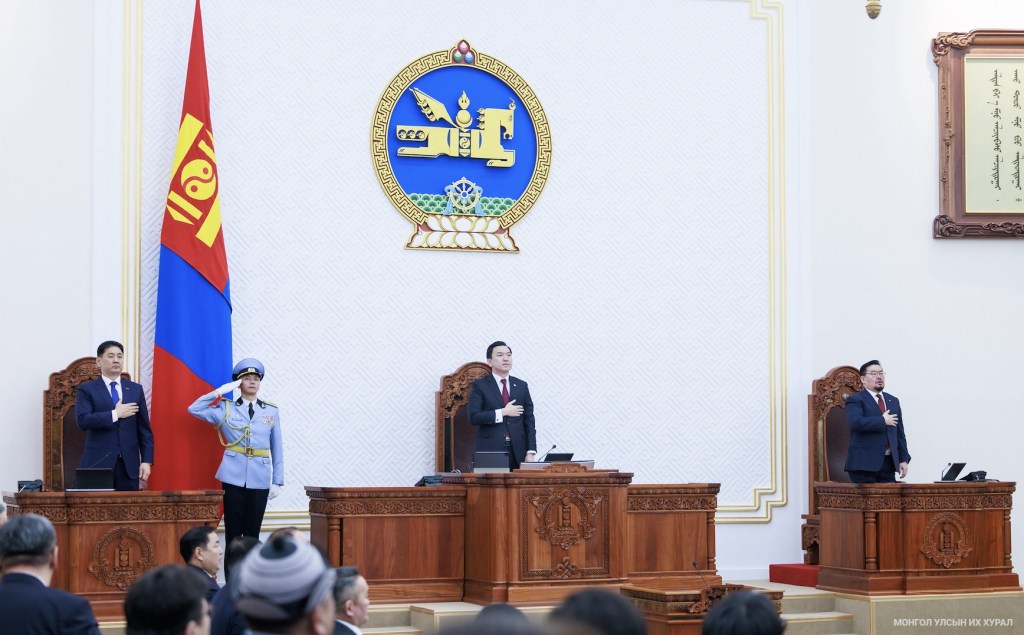
Mongolia’s Parliament opened its spring session on March 16 with an agenda centered on economic legislation, fiscal planning, and institutional reform. Parliament was expected to consider budget framework discussions, tax adjustments, and regulatory measures aimed at stabilizing the economy. Instead, the opening days of the session have been marked by an opposition boycott, failure to reach quorum, and visible divisions within the ruling Mongolian People’s Party (MPP), preventing Parliament from convening and turning the session into a political standoff.
The inability of Parliament to convene despite a clear numerical majority has changed the nature of the session. Rather than functioning as a legislative body, it has become the main arena for political competition, where actors are testing control over procedures, leadership positions, and the direction of Mongolia’s politics. What is unfolding is not a procedural breakdown, but a struggle over control within the ruling party, now being fought through Parliament. The following analysis examines how internal factional divisions, pressure on parliamentary leadership, and constraints on the Prime Minister are shaping this contest.
Fragmentation Within the Ruling Party as the Central Driver
At the core of the current instability is not new fragmentation, but the reactivation of existing factional divisions within the MPP. With 68 seats, the party still holds a clear numerical majority. However, recent failures to reach quorum and inconsistent participation by its own members show that internal divisions still remain and affect how Parliament functions.
These divisions are based on competing factions and alignments that have persisted since the 2024 parliamentary elections and during the dismissal of the Cabinet in June 2025. They are organized around different political camps, including a bloc linked to former Prime Minister L.Oyun-Erdene, and are now shaping parliamentary behavior more visibly. This has become clearer following President U.Khurelsukh’s proposed amendments to the Law on the State Great Khural, which would introduce a mechanism to recall MPs for ethical breaches and criminal misconduct.
The proposal, along with the recent expulsion of several high-profile party members, has shifted political incentives and raised concerns among some factions, particularly those tied to former leadership figures. Attendance patterns suggest that around 20 MPs aligned with Oyun-Erdene have at times withheld participation, which is enough to block quorum despite the party’s majority. In response, these groups have used parliamentary procedures to reassert influence. As a result, votes, attendance, and procedural decisions no longer consistently follow party leadership, but instead reflect factional positioning and short-term political calculations. The current instability is therefore driven less by opposition strength and more by renewed competition within the ruling MPP.
Parliament as the Arena of Control: Uchral and Opposition Strategy
The confrontation surrounding Parliament Speaker N.Uchral has become the focal point of the current crisis. Holding both the Speakership and the MPP chairmanship, he faces direct pressure from the opposition Democratic Party (DP), which argues that a party leader should not lead a multi-party legislature. What appears to be a procedural dispute is, in practice, a political contest, as the DP’s boycott, combined with inconsistent participation from MPP members, has blocked quorum and stalled parliamentary activity.
The issue is no longer simply procedural, but about control: whether Speaker Uchral can maintain Parliament’s functionality under sustained political pressure. More broadly, it reflects an unresolved tension between party authority and parliamentary independence, and how far the ruling party can extend control over the legislative body.
Pressure on Uchral is not coming from the opposition alone. Within the MPP, some actors appear to be using the situation to push for leadership changes, including the possibility of replacing the Speaker. This suggests that the current leadership arrangement may be less stable than it appears, and increasingly shaped by ongoing internal negotiations rather than firm party control.
The current situation leaves Uchral with limited options. If the stalemate continues, prolonged paralysis risks weakening his authority, as the inability to convene sessions becomes tied to his leadership. Maintaining both roles and enforcing discipline could restore control, but only if quorum is re-established. Stepping down as Speaker while retaining party leadership could ease immediate pressure, but would create space for rival factions to gain influence over Parliament. A negotiated compromise could allow Parliament to resume functioning, but would not resolve the underlying tensions.
Even if parliamentary activity resumes, the conflict is unlikely to fade. Instead, it is likely to shift to the executive branch, where competing actors may seek to renegotiate influence through cabinet positions and other arrangements.
Zandanshatar’s Political Constraint
Prime Minister G.Zandanshatar now finds himself at the center of this evolving situation, facing constraints that limit how decisively he can act. His apparent willingness to consider concessions, including replacing ministers and adjusting deputy minister appointments, reflects an attempt to stabilize the situation in the short term. However, this approach carries the risk of encouraging further demands from both internal factions and opposition parties. On the other hand, a more assertive approach, enforcing discipline and resisting pressure, could escalate tensions and deepen divisions within the ruling party. This leaves the Prime Minister balancing between concession and confrontation under increasingly constrained conditions.
Zandanshatar’s situation is further complicated by his longer-term political ambitions. He cannot simultaneously remain in office, preserve government stability, and fully prepare for a presidential bid. One of these objectives is likely to give way. In practice, this means he is no longer able to follow his preferred timeline, which would have allowed him to remain in office into late 2026, demonstrate economic and governance results, and transition into a presidential campaign from a position of strength.
This leaves him with a narrow set of options. Continuing with concessions may help him stay in office in the short term, but risks weakening his authority over time. Attempting to assert control could strengthen his position if successful, but carries a real risk of escalation. A controlled transition, including a potential early exit, could preserve political capital, but would require careful timing. Which path he takes will depend less on formal authority and more on how the internal balance of power within the ruling party evolves in the coming weeks.
Conclusion
The opening of Mongolia’s 2026 spring parliamentary session has quickly moved beyond its formal legislative agenda to become a test of political control. What was expected to focus on economic reform is instead unfolding as a contest shaped by intra-party competition, institutional pressure, and shifting leadership dynamics.
At the center of this process is not a sudden breakdown of party unity, but the reactivation of existing factional divisions under new political incentives. As these divisions become more visible and begin to shape parliamentary behavior, the system’s ability to function is being tested.
The trajectory of the current situation will depend less on formal parliamentary arithmetic than on whether the ruling party can re-establish internal coordination. If this coordination cannot be restored, the current trajectory points toward further escalation. Under such conditions, pressure may shift toward broader involvement, where the President Khurelsukh’s position could become important in stabilizing the situation, given his past involvement during periods of political crisis. If unresolved, these dynamics are likely to intensify as Mongolia moves closer to the 2027 presidential election.
 Арктус Аналитикс ХХК
Leave a comment