

Bolor Lkhaajav | Policy Consultant, Op-Ed Contributor – Arctus Analytics
In commemoration of Mongolia and Italy’s 55th diplomatic anniversary, the Mongolian President Khurelsukh Ukhnaa paid a three-day state visit to Rome and the Vatican from December 1-4th. The President’s visit marks a historical milestone as he was the first sitting Mongolian President to visit Italy in 14 years. During Khurelsukh’s state visit to Rome, Mongolia and Italy not only became strategic partners, but Mongolia also deepened diplomatic connections with the Vatican.
The diplomatic relations that we understand in our modern times began for Mongolia and Italy in 1970. But historical accounts, travelers’ stories and journals link the Mongols to the societies of Perugia and Umbria (modern day Central Italy) dating back to the Franciscan friar Giovanni da Pian del Carpine in 1245, and later Marco Polo in 1292. A historian in Medieval Europe, Mark Cruse wrote about these encounters in his book, the Mongol Archives. He wrote about the knowledge of the Mongols, “The early reports by the monks John of Plano Carpini (an Italian), Simon of Saint-Quentin (a Frenchman), and Rubruck describe everything from law and religion to dress and battle tactics and are among the most important sources we have on medieval Mongol society.” While these medieval encounters belong to a distant era, they highlight long-standing linkages that continue to inform Mongolia’s engagement with Europe in both historical and contemporary contexts.
Since establishing formal diplomatic relations in 1970, Mongolia and Italy signed several important bilateral agreements to support cooperation mechanisms. In 1993, Mongolia and Italy signed the Bilateral Investment Treaty. The agreement, at the time, aimed to establish favorable conditions for Italian businesses and investors to seek investment in Mongolia’s newly established market economy. When Mongolia opened its Embassy in Rome in 2011, Mongolia’s third-neighbor foreign policy was just taking its shape. To Mongolia’s economic goals, vis-à-vis its third neighbor policy, having an Embassy in Rome also meant access to other European connections.
In 2016, Italy opened its Embassy in Ulaanbaatar, and Ettore Francesco Sequi was appointed as Ambassador. Since then, Italy has appointed two other Ambassadors to Mongolia, Laura Botta and the incumbent Giovanna Piccarreta. Tserendorj Narantungalag is currently serving as Mongolia’s Ambassador to Italy.
Mongolia and Italy’s cultural relations have triumphed in the last decade. Italy has become one of Mongolia’s strongest supporters in the arts and entertainment industry. For example, since 2015, the Mongolian Contemporary Art Support Association (MCASA) organized Mongolian Pavilions at Venice Art Biennale. Mongolia became a regular participant in 2017, 2019, 2022, and 2024.
In 2024, Italy had the privilege to exhibit one of its most revered artworks of the Baroque era. The Chinggis Khaan National Museum in Mongolia exhibited Caravaggio’s “Whispers of light, restoration of a masterpiece” showcasing the very original piece, known as “Mary Magdalene in Ecstasy.” Mongolian exhibitionists and artists have had the opportunity to work with Dr. Cinzia Pasquali, a well-known art restorer. During the exhibit opening ceremony, Italy’s Ambassador to Mongolia, Giovanna Piccarreta emphasized that,“Italy is famous in the world of art of restoration, and it has been a long tradition.” The Caravaggio exhibit was part of a burgeoning cultural diplomacy between Italy and Mongolia. Such cultural ties have set a strong foundation for expanding cooperation into more strategic domains, including education, tourism, and other industries.
While Mongolia and Italy have triumphed culturally and artistically, foreign direct investment and bilateral trade lacked for years. Mongolia typically runs a trade surplus with Italy – particularly importing Mongolian products such as wool and animal hair. According to preliminary 2025 estimates, Mongolia–Italy trade reached 45 million USD. Despite this relatively modest trade volume, both governments view the partnership as a platform to unlock new cooperation in textiles, luxury supply chains, value-added cashmere processing, and green-technology manufacturing. The diplomatic anniversary offered a timely chance to reassess economic cooperation, with Khurelsukh’s state visit becoming the pivotal occasion to upgrade bilateral relations at the highest level.
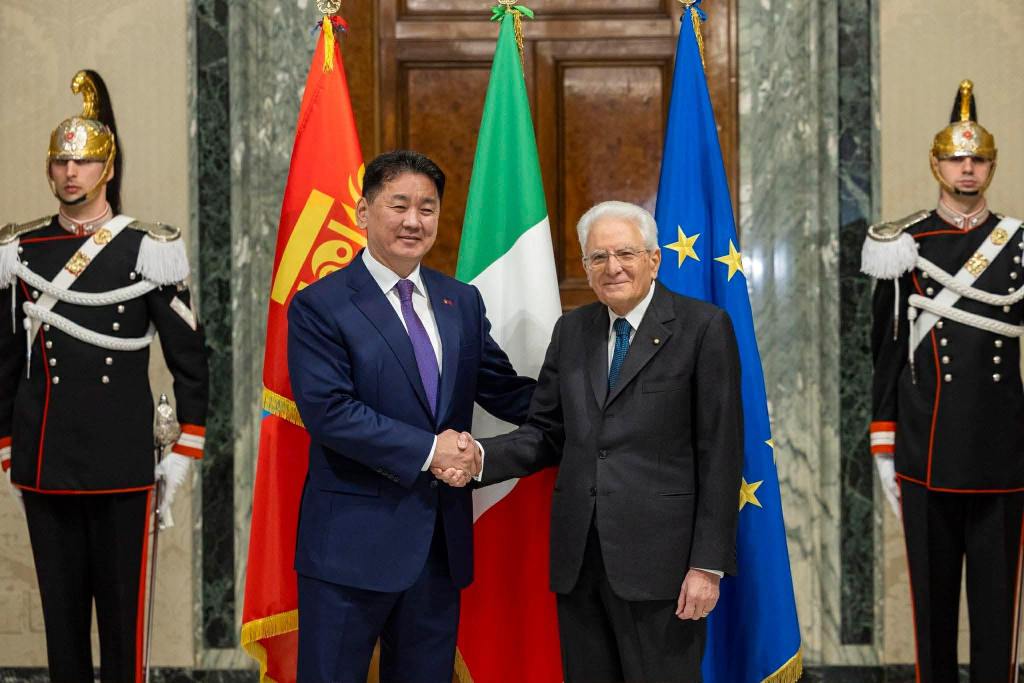
During the official talks between the Mongolian President Khurelsukh Ukhnaa and Italy’s President Sergio Mattarella, Ulaanbaatar and Rome declared Strategic Partnerships, making Italy the second European Union member state to establish a strategic partnership with Mongolia, after Germany.
The Joint Declaration on Strategic Partnership between Mongolia and Italy included several major agreements which can boost economic links between the two countries. The bilateral agreement includes but is not limited to increasing cooperation in air service, critical minerals and raw materials, civil protection, and disaster risk management. In addition to augmenting sector-to-sector cooperation between the two governments and their agencies, city-to-city partnerships will be implemented in Mongolia’s Uvurkhangai and Arkhangai provinces.
Moreover, Mongolia and Italy signed a 2025-2028 program which aims to deepen cooperation in education, science, culture, and sports, and tourism. As part of Mongolia’s efforts to diversify its economy, tourism has become a major push. The Mongolia–Italy Aviation Agreement created a legal framework for potential direct flights between Ulaanbaatar and Italian cities. According to 2018 estimates, 11,850 Italian tourists have visited Mongolia, and these numbers are expected to increase.
The Mongolian President Khurelsukh’s visit to Italy also provided an occasion to visit the Vatican. When the late Pope Francis visited Mongolia, the relations between the Holy See and Mongolia saw an immense uplift. Khurelsukh’s state visit to the Vatican and meeting with the Pope Leo XIV demonstrates a continuation of Mongolia’s historic link with the Vatican but also manifests the country’s religious freedom.
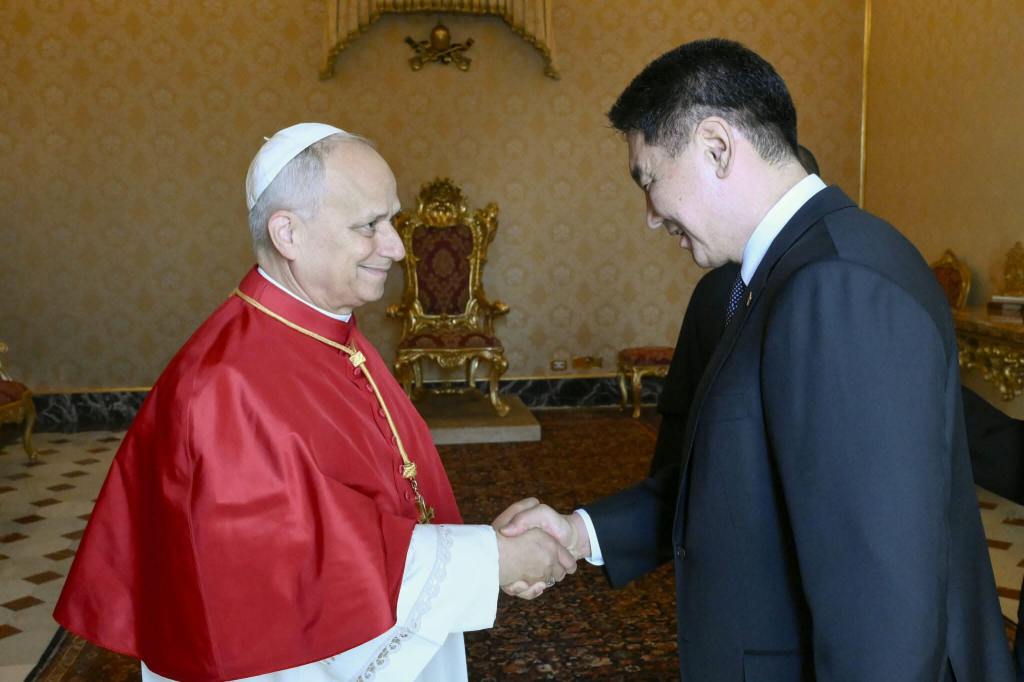
According to the Catholic Church in Mongolia, Mongolian Presidents Bagabandi Natsag, and Elbegdorj Tsakhia have previously visited the Vatican on official visits, but Khurelsukh is the first to undertake formal state visit to the Holy See, which carries higher diplomatic protocol.
Mongolia and the Holy See will specifically delve into scholastic cooperation in discovering Mongolian historical archival documents and materials preserved in the Vatican Apostolic Archives. The Office of the Catholic Church in Mongolia further stated that “the two sides reaffirmed their commitment to continue cooperation to expand collaboration” and “thereby presenting their ancient ties to the public.” Mongolia recently embarked on a similar approach with India to digitalize ancient Buddhist scripts.
Marking the 55th anniversary of their diplomatic ties, Mongolia and Italy both see the moment as an opportunity to elevate their political, economic, and cultural relationship to a strategic tier. In the last decade, Italy’s investment in Mongolia has been strategically focused on sectors that push for value-added productions. With global momentum shifting toward green technology, Italy is increasingly seeking reliable partners to strengthen its supply chains. The strategic partnership between Mongolia and Italy, in a way, is a shift from traditional trade relations in raw materials to sustainable value chains, critical raw materials, as well as infrastructure in green energy. Both governments are looking ahead to the next fifty years with the expectation of building an even more robust and comprehensive bilateral partnership.
The author wrote on the late Pope Francis’ State Visit to Mongolia in 2023, link.
 Арктус Аналитикс ХХК
Leave a comment