
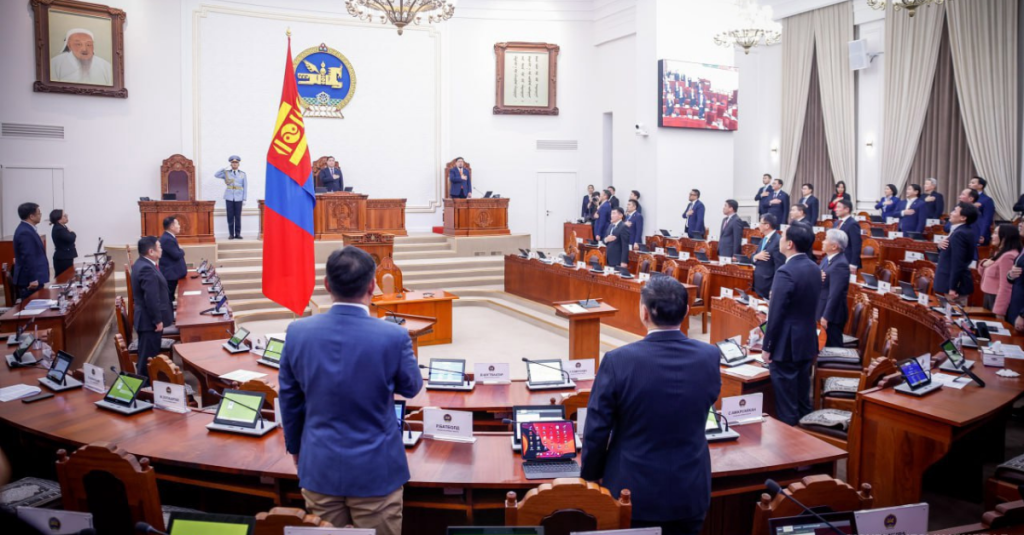
While the Constitutional Court restored order in Ulaanbaatar, political infighting and corruption scandals risk weakening Mongolia’s third-neighbor diplomacy and deepening reliance on China and Russia.
An unprecedented moment in Mongolia’s politics, with the Prime Minister and the Parliamentary Speaker resigning on the same day, has again tested the resilience of a democracy caught between Russia and China.
When Mongolia’s Constitutional Court reinstated Prime Minister G.Zandanshatar on October 22, it averted what could have been the country’s third change of government since the 2024 parliamentary elections. The Court found that Parliament’s decision to dismiss the Prime Minister had violated the Constitution. The Court found multiple procedural violations, including an irregular voting formula that effectively reversed the logic of the motion and an attendance count that combined two separate plenary sessions to meet quorum.
The ruling restored Zandanshatar’s government, ended weeks of confusion, and reestablished constitutional order. Yet while the judiciary stabilized the situation, the episode exposed the deeper instability within the ruling Mongolian People’s Party (MPP), whose factional rivalries could keep the country in a state of political turbulence through the 2027 presidential and 2028 parliamentary elections.
The latest attempt to unseat the Prime Minister was led by allies of former Prime Minister L.Oyun-Erdene, who lost power earlier this year and has sought to test the new administration ahead of the MPP leadership contest scheduled for November 15-16. For a moment, the maneuver seemed likely to trigger another round of upheaval. Instead, the public largely tuned out, weary of leadership changes presented as national crises, and the Constitutional Court refused to play along.
In parallel, Parliament Speaker D.Amarbayasgalan, who had played a central role in initiating the motion to dismiss the Prime Minister, resigned from his post after facing mounting ethical and corruption allegations. His resignation, accepted by 102 of 114 lawmakers, left both the Prime Minister’s and the Speaker’s offices vacant for the first time in recent history. Soon after, prosecutors named Amarbayasgalan a suspect in a criminal investigation into abuse of power, bribery, and illicit enrichment linked to the Tavan Tolgoi coal field. The Independent Authority Against Corruption confirmed that the case is now under active investigation. His downfall, unfolding just weeks before the ruling party’s congress, has further deepened divisions within the ruling MPP and underscored how political rivalries are increasingly colliding with corruption probes.
Although Mongolia’s democracy has survived another institutional stress test, its politics remain volatile. The ruling party remains deeply divided, with both major factions preparing for what comes next: election of the next Parliament Speaker and the party’s next chair.
The frequent leadership turnover has become a norm in Mongolia. In three decades of democracy, only two governments have completed full four-year terms, with governments lasting an average of 1.8 years. The Zandanshatar government, formed in June, is already vulnerable to renewed challenges from within his party. If this cycle of short-lived governments continues, the consequences will extend across the economy, state institutions, and international partnerships.
First, constant government turnover threatens to stall Mongolia’s policy agenda at a critical moment for the economy. Each new cabinet reshuffles ministers, restarts policy priorities, and delays implementation. The previous Oyun-Erdene government outlined fourteen “mega projects”, with the Mongolia–China cross-border Gashuunsukhait-Gantsmod railway at top of the list. The Intergovernmental Agreement on the Gashuunsukhait-Gantsmod Cross-Border Railway, Coal Trade, and the Expansion of Tavan Tolgoi Coal Mine Capacity, signed in February 2025, is already facing scrutiny in Parliament. After Oyun-Erdene’s dismissal, lawmakers initiated a motion to form a temporary committee to review the coal purchase agreement, arguing that prices may have been set below market value. In addition, the current government has postponed five of the fourteen mega projects due to budget cuts and has recently announced its own Five-Year Development plan for 2026-2030 that identifies 87 priority projects with a projected cost of 66.6 trillion MNT.
As successive governments change policy priorities and focus on short-term political survival, major projects are repeatedly delayed or scrapped. For a country that depends on steady mining exports, frequent cabinet changes erode investor confidence and complicate negotiations with international partners. Mongolia’s ability to attract stable foreign capital, especially in large-scale infrastructure and mining ventures, depends on predictable governance. Prolonged uncertainty risks further dampening investor confidence and slowing growth just as the country is emerging from the fiscal strains of the COVID-19 pandemic and global commodity fluctuations.
Persistent political deadlock and operational uncertainty undermine morale within the bureaucracy and weakens implementation across ministries. Long-term planning becomes difficult as new administrations often reset priorities before existing policies take effect.
Secondly, instability erodes the effectiveness of Mongolia’s “third neighbor” foreign policy, the strategy of balancing ties with China and Russia through partnerships with democratic nations such as Japan, South Korea, India, and the United States. Diplomatic engagement requires consistency and coherent messaging, but when governments change every few months, priorities shift and momentum is lost. Foreign investors and diplomats are faced with uncertainty about which policies will survive the next reshuffle.
Meanwhile, Mongolia’s immediate neighbors are capitalizing on the country’s distracted politics. China continues to dominate trade, accounting for about 91 percent of Mongolia’s exports in the first half of 2025, while Russia has tightened its grip on Mongolia’s energy supply and transport corridors.
The breakthrough on the Russia–China–Mongolia gas pipeline underscores how regional integration often proceeds on terms defined by China and Russia. Even in times of stability, Mongolia’s small size and location make it a participant rather than an active player between its two neighbors. Recurring political turmoil narrows its space to negotiate or seek alternative partnerships. As leaders cycle through short-lived governments, strategic projects move forward largely by default, binding Ulaanbaatar more tightly to Beijing and Moscow.
The recent fuel shortage offered another reminder of Mongolia’s growing reliance on its neighbors. In October, Ulaanbaatar requested increased fuel deliveries from Russia to ease shortages of AI-92 gasoline, while China agreed to double its own Euro-5 exports to fill the gap. Kazakhstan signaled a readiness to supply fuel as a third source, yet talks have stalled. The result is a familiar pattern: even as Mongolia talks about diversifying its import sources, it continues to depend on Russia and China for basic energy needs. Political instability does not create this dependence, but it prevents the government from developing the steady policy coordination needed to reduce it.
Diplomatically, Ulaanbaatar still praises its “third neighbors” and seeks a multi-pillared foreign policy, but recent developments have favored projects that bind Mongolia’s economy and infrastructure to China and Russia. The more domestic politics drift, the harder it becomes to maintain strategic balance. Dependence on its neighbors will deepen not by deliberate policy choice but through political fatigue and lack of alternatives. To its credit, the Constitutional Court’s ruling in this case shows that Mongolia’s institutions can still uphold constitutional order against political overreach. But institutional resilience alone cannot substitute for political discipline.
Compared to the ousting of Oyun-Erdene’s government in June 2025, when youth protests demanded his resignation, this time few rallied in the streets to defend or condemn Prime Minister G.Zandanshatar. Ordinary Mongolians appear to want less confrontation and more continuity. They hope for competent governance and tangible economic progress.
For a country sandwiched between Russia and China, engagement with its two neighbors remains inevitable and economically necessary. Energy cooperation, transit infrastructure, and market access are vital lifelines for a landlocked economy. But unless future governments can pair these pragmatic partnerships with consistent domestic policy and stronger institutions, Ulaanbaatar will continue to react to its environment rather than shape it. The real test for Mongolia’s democracy is not whether it can endure another crisis, but whether it can finally build the stability to outgrow one.


Leave a Reply