
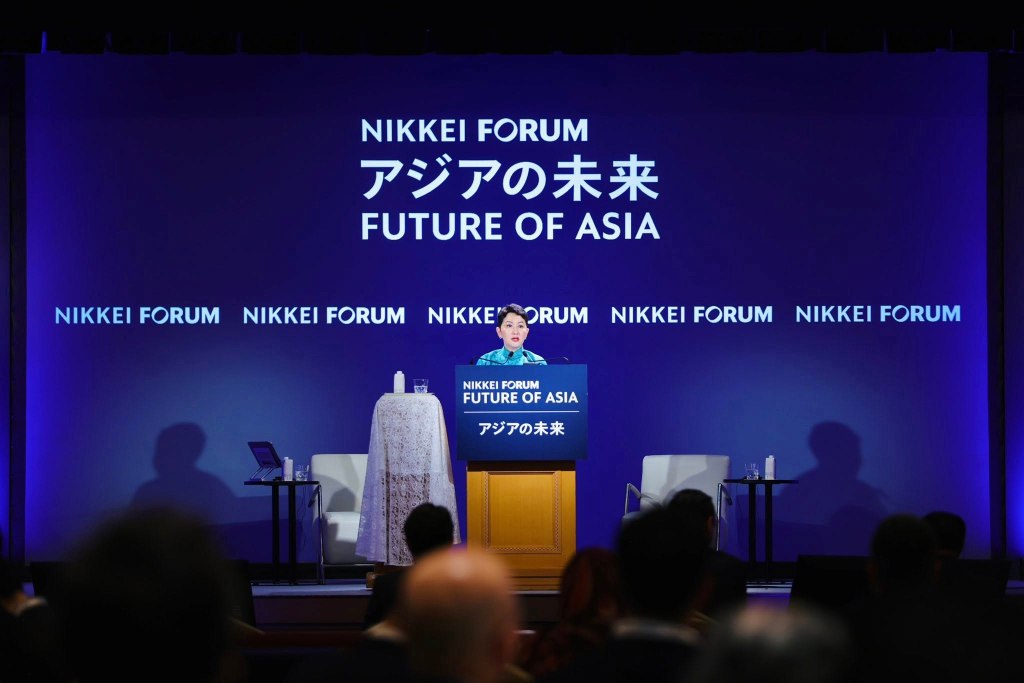
The Future of Asia international forum, organized annually by Japan’s Nikkei, is being held in Tokyo. The forum brings together leading figures from political, economic, and academic circles across the Asia-Pacific region to exchange views on regional challenges and Asia’s role in the world. This year, Mongolia’s Minister for Foreign Affairs, B.Battsetseg, participated as a speaker and presented Mongolia’s foreign policy position. The forum is discussing a wide range of issues, including economic growth, trade and investment, geopolitical competition, security, supply chain risks, energy transition, climate change, and artificial intelligence.
Mongolia seeks to avoid taking one side in international confrontations, maintain equal relations with all parties, keep channels of understanding open, and contribute to regional peace and stability. In this context, Mongolia’s voice is gaining greater weight and influence on the regional stage. Foreign and domestic observers have at times described Mongolia’s foreign policy as a balanced foreign policy and, at other times, as a neutral policy. However, over the past several years, Mongolia’s position has increasingly gone beyond simply maintaining balance, staying neutral, and carefully observing developments in international relations. It can be seen as moving toward a more proactive neutral approach. In a broader sense, and at a higher level of responsibility, this policy can be described as a “proactive neutral policy.”
A proactive neutral policy does not mean a passive, weak, or detached position that merely seeks to remain isolated from conflict. Rather, it represents a responsible choice: not aligning with one side, while serving as a bridge for understanding, trust, and dialogue, and contributing to the strengthening of regional stability.
A clear example of this policy is the recent Ulaanbaatar Dialogue on Northeast Asian Security, held in Ulaanbaatar. The dialogue demonstrated that Mongolia is not merely a country that carefully observes complex regional issues, but can also serve as an international platform for strengthening trust, preserving channels of dialogue, and openly discussing common security challenges.
Northeast Asia is a unique region. It is home to some of the world’s most powerful economies and advanced technology centers, yet it lacks an integrated regional security mechanism. The Korean Peninsula issue, strategic competition among major powers, nuclear risks, historical mistrust, and emerging technology-related security challenges all contribute to the fragility of regional stability. Under such conditions, Mongolia seeks to keep open the possibility of dialogue among opposing parties.
Mongolia is a nuclear-weapon-free state, maintains friendly relations with its two neighbors and third neighbors, and upholds international law, the UN Charter, and the principles of peace. This position enables Mongolia to be seen not as a party to confrontation, but as a potential platform for building trust.
The theme of the 31st Nikkei Future of Asia forum, “Working Together for a More Resilient and Prosperous Asia,” aligns with the recent direction of Mongolia’s foreign policy. “Resilient” implies the ability not to escalate conflicts, but to manage and resolve them, while “prosperous” refers not only to economic growth, but also to an Asia capable of overcoming crises through collective effort and building its future together.
For Mongolia, Asia’s future should not be seen as an issue to be decided only by major powers with large economies. Smaller states also have an important role to play in maintaining regional trust, understanding, and open diplomatic channels. Asia’s future should therefore be the result of collective efforts by Asian countries. Minister for Foreign Affairs B.Battsetseg’s participation and speech at this year’s Nikkei forum provided an opportunity to highlight some of Mongolia’s key foreign policy messages on the international stage. Mongolia does not merely proclaim peace; it seeks practical ways to support peace and develop stable multilateral mechanisms for dialogue. For Mongolia, neutrality does not mean passivity. It reflects an aspiration to serve as an international platform for dialogue capable of addressing confrontation through trust and understanding. Similarly, pursuing a balanced foreign policy means not only protecting itself from risks, but also actively contributing to regional stability.
In her speech, Minister B.Battsetseg noted that what Asia needs today is not only infrastructure development, investment, or new technologies, but also a new culture of trust, understanding, cooperation, and responsibility. She emphasized that Mongolia, through its history, geographic position, diplomatic tradition, and peaceful foreign policy, has the potential to contribute to the work of building Asia’s future.
The diplomatic line extending from the Ulaanbaatar Dialogue to the Nikkei Forum in Tokyo reflects the stability, balance, and active nature of Mongolia’s foreign policy. It also demonstrates Mongolia’s aspiration to serve as a bridge of trust and understanding, and to make its voice heard internationally in support of peace and stability.
Mongolia’s proactive neutral policy shows that even a small state can make a meaningful contribution to global peace and regional stability. At the same time, it supports Mongolia’s broader foreign policy objective of becoming not merely a landlocked country, but a “land-linked” state deeply and broadly engaged in regional integration. How this objective will be advanced in practice, and what results it may produce in the near term, will depend on high-level visits, the continuity of the Ministry of Foreign Affairs’ policy, and the outcomes of regional and multilateral diplomatic initiatives.
 Арктус Аналитикс ХХК
Leave a comment